Emily Dickinson What Effect Do the Dashes Have on Your Reading and Understanding of the Poem
A reading of a classic Dickinson verse form by Dr Oliver Tearle
'Tell all the Truth simply tell information technology camber' is verse form number 1129 in Emily Dickinson'due south Complete Poems 
Tell all the Truth but tell it slant –
Success in Circuit lies
Too vivid for our infirm Delight
The Truth's superb surprise
Every bit Lightning to the Children eased
With explanation kind
The Truth must dazzle gradually
Or every man be blind –
Summary
In summary, Dickinson says that we should tell the truth – the whole truth – but tell it indirectly, in a circuitous and round-the-houses mode. The truth, she says, is likewise bright and dazzling for united states to be able to cope with it in 1 go. We can exist overwhelmed by it.
The 2nd stanza introduces the one simile of the poem: the way that lightning and thunderstorms are explained to children in kinder terms ('eased'), so every bit not to frighten them. Dickinson concludes by saying that the truth, if shown too directly, has the power to blind us.
Analysis
 In other words, we might analyse Dickinson's poem as follows: she is arguing that we humans cannot handle besides much truth, that we, to borrow T. South. Eliot'southward words, cannot bear very much reality. We are imperfect creatures, and the truth is too pure and good for our 'infirm', or diseased and weak, 'Delight'.
Dickinson is writing before the phrase 'being economical with the truth' was coined, but her verse form raises a similar question.
Is this the aforementioned as flat-out lying? It would seem non, though the give-and-take 'lies', couched every bit so ofttimes in its potential double significant (be supine/tell falsehoods), is there in the poem'southward 2nd line.
Ane of the most compelling readings of this verse form was offered by another poet, Anthony Hecht (1923-2004). Hecht argued that 'the Truth' which Dickinson refers to might exist interpreted specifically as religious truth (Jesus' words 'I am the way, the truth, and the life' in John xiv:6, for case), and that nosotros are not meant to sympathise the 'Truth' of God direct.
This is why nosotros demand holy texts that address themselves to us in the form of riddles and symbols.
What makes such an analysis of 'Tell all the Truth only tell information technology slant' persuasive is that Christianity is full of such references to beingness 'blinded' past the truth. For instance, there is 1 Corinthians thirteen:12: 'For now we come across through a glass, darkly; but and then confront to face.'
Tell all the Truth only tell it slant –
Success in Circuit lies
Too brilliant for our infirm Please
The Truth'due south superb surprise
And certainly, as nosotros tin can see in this opening stanza, Dickinson associates truth with light in this verse form, suggesting that this truth carries the potential for enlightenment, whether religious, spiritual, or otherwise.
Another of her poems begins, 'At that place'south a sure Slant of lite'; here, we accept the truth being told 'slant', and then 'Lightning', suggesting a dazzling, vivid light (the 'Low-cal' of 'Lightning' coming to united states via the 'light' peeping out from 'please', which itself has emerged from a sliver of light nowadays in 'lies').
Indeed, the repeated open up 'i' sounds in the words Dickinson chooses to end her lines – 'lies', 'Please', 'surprise', 'kind', 'bullheaded' – call to mind the optics and the importance of the visual, of seeing the truth. (Compare, in this connection, a much earlier verse form, by the Elizabethan poet Sir Philip Sidney: Sidney besides ends each of his lines with an i sound.)
And the words 'dazzle' and 'blind' in that second stanza phone call to mind the idea of staring directly at the sun. Dickinson doesn't mention the dominicus in this poem, just this may be what she is hinting at in the concluding 2 lines of the verse form.
Just for Helen Vendler, in her vivid volume of close readings, Dickinson 
But Dickinson's motive for 'slanting' the truth is different from Jesus': she doesn't want to hide the truth from those who practice not want to meet it, but instead she wishes to make the truth more than palatable to those who run the chance of existence 'blinded' by information technology, equally by the sun'southward glare.
Equally the famous line from the 1992 picture show A Few Expert Men has it, 'You can't handle the truth!' At that place are times in all of our lives when nosotros would rather bury our heads in the sand and run away from harsh reality; making reality a little less harsh is the sermon Dickinson appears to exist preaching here.
As Lightning to the Children eased
With explanation kind
The Truth must dazzle gradually
Or every human be blind –
Merely every bit very small children do not empathise lightning and where information technology comes from, so parents soften this truth to them, then Dickinson seeks to soften the 'lightning' power of truth. Vendler'due south summary of Dickinson's poem is a compelling i, and it raises broader questions near poetry as parable. So often in Dickinson'south verse – her celebrated poem about truth and beauty being but one example – she presents u.s.a. with symbolic situations which attempt to illuminate some profound truth.
But rather than addressing these bug directly, Dickinson cloaks them in metaphor, in unusual imagery, or in arrestingly original symbolism.
'Tell all the Truth but tell information technology slant' has a dandy opening line, and Emily Dickinson puts forward the 'argument' of the poem using powerful and memorable imagery. Simply ultimately what sort of 'Truth' she has in heed – if she does have a particular truth in listen here – remains unstated. And perhaps that is what gives the poem its power; when information technology comes to the truth the poem itself seeks to tell, information technology cannot assist but 'tell it slant'.
Nigh Emily Dickinson
Perhaps no other poet has attained such a loftier reputation after their death that was unknown to them during their lifetime. Born in 1830, Emily Dickinson lived her whole life within the few miles effectually her hometown of Amherst, Massachusetts. She never married, despite several romantic correspondences, and was meliorate-known as a gardener than as a poet while she was live.
Nevertheless, information technology's not quite truthful (as it's sometimes declared) that none of Dickinson's poems was published during her own lifetime. A scattering – fewer than a dozen of some 1,800 poems she wrote in total – appeared in an 1864 album, Drum Trounce, published to raise money for Wedlock soldiers fighting in the Civil War. Just it was four years afterwards her death, in 1890, that a volume of her poesy would appear before the American public for the showtime time and her posthumous career would begin to have off.
Dickinson collected around viii hundred of her poems into piffling manuscript books which she lovingly put together without telling anyone. Her poesy is instantly recognisable for her idiosyncratic use of dashes in identify of other forms of punctuation. She often uses the four-line stanza (or quatrain), and, unusually for a nineteenth-century poet, utilises pararhyme or half-rhyme as often every bit full rhyme. The epitaph on Emily Dickinson's gravestone, equanimous by the poet herself, features just two words: 'called dorsum'.
Keep to explore Dickinson's verse with this pick of her ten greatest poems, her beautiful poem near dying, and her enigmatic poem about a snake in the grass. If you want to own all of Dickinson'south wonderful poetry in a unmarried volume, you can: nosotros recommend the Faber edition of her Consummate Poems
The writer of this article, Dr Oliver Tearle, is a literary critic and lecturer in English at Loughborough University. He is the author of, among others,The Secret Library: A Volume-Lovers' Journey Through Curiosities of History 
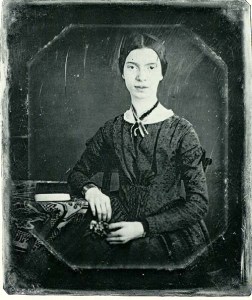
Image: Blackness/white photograph of Emily Dickinson past William C. Northward (1846/vii), Wikimedia Commons.
Source: https://interestingliterature.com/2016/11/a-short-analysis-of-emily-dickinsons-tell-all-the-truth-but-tell-it-slant/
0 Response to "Emily Dickinson What Effect Do the Dashes Have on Your Reading and Understanding of the Poem"
Yorum Gönder